Aspirin and clopidogrel reduce platelet reactivity through different molecular targets. Aspirin irreversibly acetylates platelet cyclooxygenase-1 (COX-1) and suppresses thromboxane A₂ generation. The active metabolite of clopidogrel irreversibly inhibits the platelet P2Y₁₂ ADP receptor. Agonist-based testing can therefore examine how platelets respond when challenged with arachidonic acid (AA) or adenosine diphosphate (ADP). However, these readouts are agonist-related rather than absolutely pathway-specific: platelet signaling pathways interact, and ADP-induced CD62P mobilization involves both P2Y₁ and P2Y₁₂ receptors. Results must be interpreted using a validated, assay-specific protocol and in the broader clinical context.
1. Two agonist challenges, one CD62P readout
|
Agonist challenge |
Primary signaling context |
Quantitative readout |
Associated drug context |
|
AA |
COX-1 / thromboxane A₂-related signaling |
Agonist-induced CD62P expression |
Aspirin exposure |
|
ADP |
P2Y₁ and P2Y₁₂ receptor signaling |
Agonist-induced CD62P expression |
Clopidogrel or another P2Y₁₂ inhibitor |
The pathways are biologically distinct but interconnected. AA- and ADP-induced results are not interchangeable, and neither response should be described as completely drug-specific.
Why CD62P? CD62P (P-selectin) is stored in platelet alpha-granules and becomes exposed on the platelet surface following activation and granule secretion. Measuring CD62P after an agonist challenge provides a cellular marker of alpha-granule release—one component of platelet activation. It does not by itself provide a complete assessment of platelet adhesion, aggregation, procoagulant activity, or overall bleeding and thrombotic risk.
|
Aspect |
AA challenge |
ADP challenge |
|
Agonist |
Arachidonic acid (AA) |
Adenosine diphosphate (ADP) |
|
Primary signaling context |
AA metabolism via COX-1 and thromboxane A₂ generation |
Signaling through both P2Y₁ and P2Y₁₂ receptors |
|
Drug-related context |
Aspirin exposure |
Clopidogrel or another P2Y₁₂ inhibitor |
|
Readout |
AA-induced CD62P expression |
ADP-induced CD62P expression |
|
Functional information |
Residual AA-induced responsiveness associated with the COX-1/thromboxane pathway |
Residual ADP-induced responsiveness relevant to P2Y₁₂ inhibitor exposure |
|
Key limitation |
Not a universal diagnostic of “aspirin resistance”; protocol and cut-off are assay-specific |
Not P2Y₁₂-specific because ADP signaling and CD62P mobilization also involve P2Y₁ |
2. Where selective testing may add context
Platelet function testing is not recommended as a universal routine test for every patient receiving antiplatelet therapy. Contemporary expert consensus supports selective use in defined clinical settings and emphasizes that methods and decision thresholds are not interchangeable. Any CD62P result should be interpreted together with medication timing and adherence, potential drug interactions, platelet count, sample quality, clinical presentation, and other relevant laboratory findings.
|
Clinical question |
What the test may contribute |
Important limitation |
|
Unexpected ischemic event while on therapy |
May show whether substantial residual agonist-induced CD62P expression is present under a validated protocol. |
It does not identify the cause. Review adherence, dose timing, interactions, comorbidity and competing mechanisms. |
|
Unexpected bleeding or planned high-risk procedure |
May provide one measure of residual platelet responsiveness. |
Bleeding risk is multifactorial; no single CD62P result reliably predicts bleeding. |
|
Selected response assessment |
AA and ADP challenges can provide differentiated information on agonist-induced platelet responses. |
Methods, response ranges and decision thresholds are not interchangeable. |
|
Clinical safeguard A functional result can add context, but it should not independently determine whether antiplatelet therapy is started, stopped, switched, or dose-adjusted. |
||
A practical interpretation workflow
|
01 Define the clinical or laboratory question |
02 Select a validated AA or ADP protocol |
03 Quantify agonist-induced CD62P expression |
04 Interpret with controls and clinical context |
|
Standardization matters Reliable assessment requires standardized blood collection and processing, a validated anticoagulant and sample type, controlled time from collection to testing, defined agonist concentration and incubation time, appropriate unstimulated and positive controls, and assay-specific interpretation criteria. |
|||
3. Poclight C5000: quantitative CD62P measurement after validated stimulation
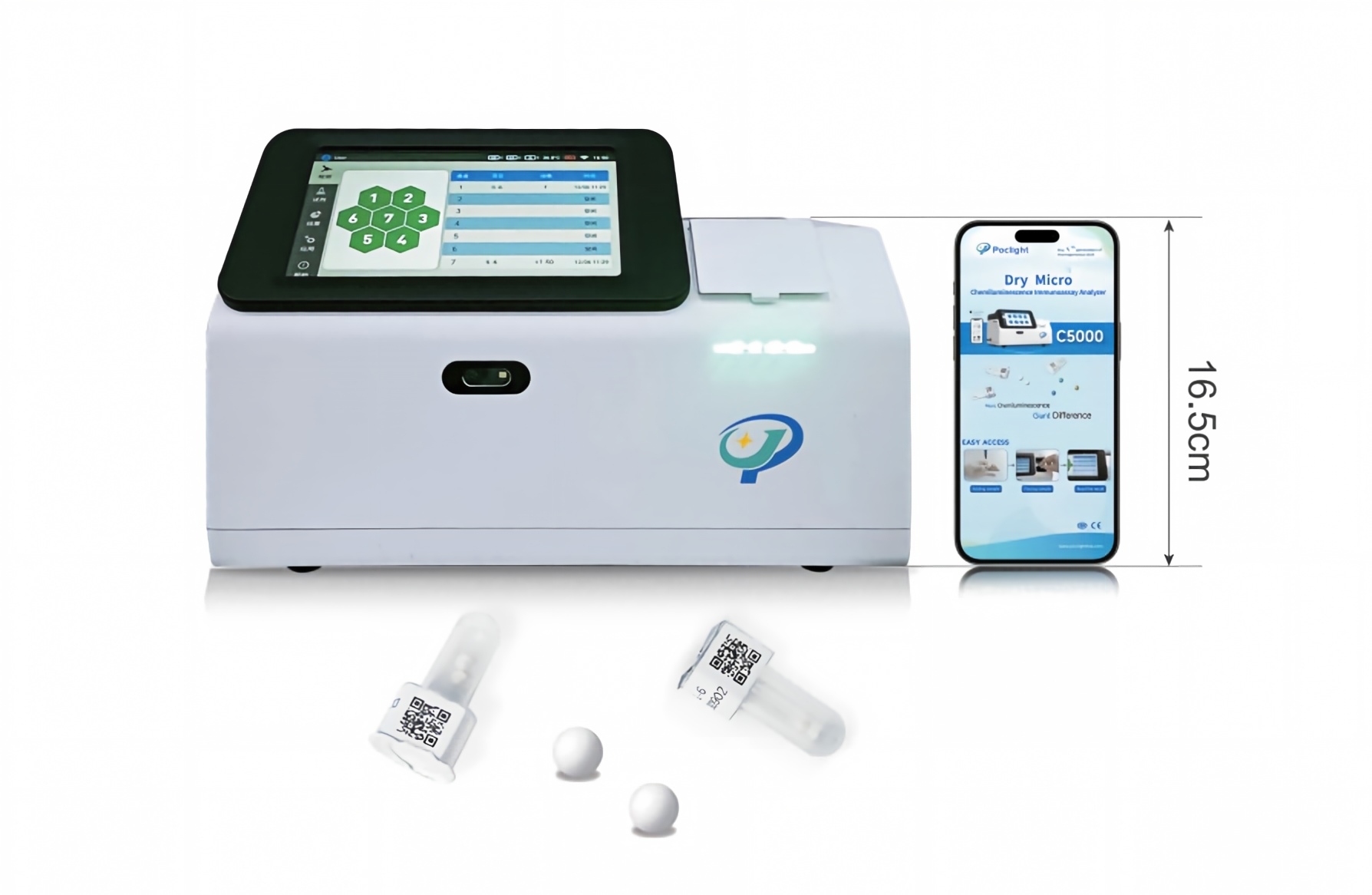
Within an AA- or ADP-stimulation workflow, the agonist challenge occurs before quantitative CD62P measurement. The C5000 reports CD62P-positive platelets according to the assay protocol; it should not be described as directly measuring a single signaling pathway.
|
|
Principle: CRET-based homogeneous chemiluminescence immunoassay CD62P sample type: Platelet-rich plasma (PRP) or whole blood CD62P reaction time: 5 min CD62P reference range: 1.04%–4.52% Platform: 7 detection channels; up to 80 tests/hour |
|
How to use the stated reference range The CD62P reference range of 1.04%–4.52% applies to the assay under its validated standard testing conditions. It is not a universal decision threshold for AA- or ADP-induced response, “aspirin resistance,” clopidogrel response, or treatment adjustment. Agonist-stimulated interpretation requires validated, assay-specific controls and criteria. |
|
4 Conclusion
AA and ADP challenge platelets through different but interacting mechanisms. When paired with quantitative CD62P measurement, they can provide differentiated information about AA- and ADP-induced alpha-granule secretion. This information may add a focused functional layer in selected laboratory or clinical contexts, but it must be interpreted with validated protocols, appropriate controls, and the broader clinical picture.



 Rede IPv6 suportada | XML | Sitemap | Blog | política de Privacidade
Deixe um recado
Digitalizar para WeChat :


 English
 français
 русский
 español
 português
 العربية
 日本語
日本語 Türkçe
 हिंदी
हिंदी Indonesia